Why Chinese museums are betting on horses
With its dark, beady eyes, delightfully dorky expression, and wild mane of hair flying in the wind, a little horse is sprinting into the spotlight. As the Chinese Year of the Horse arrives, a culturally creative product named Ma Biaobiao from the Shandong Art Museum has become a smash hit.
Dubbed the "scruffy little horse" by amused netizens, Ma Biaobiao's creation draws inspiration from the galloping horse in Qi Baishi's ink painting Such A Thousand Miles. The renowned artist is celebrated for his depictions of animals. The horse under his brush is vivid, dynamic, and features a flowing mane and tail, as if ready to leap off the paper.
Capturing the spirited charm of the original painting, the designer gave this little horse a playful twist: a fluffy, style-able mane in eight different colors. Anyone who buys the horse becomes its hairstylist, free to shape the mane into double ponytails, buns, braids, or any look they fancy.
Many fans online say that they see themselves in this scraggly steed:"My hair might be a mess, but I'm always charging forward!" Some office workers joke its unruly mane perfectly captures their look on Monday mornings.
Cui Wentao, deputy director of the Shandong Art Museum in Jinan, Shandong province, believes the product's popularity lies not only in capturing the spirit of ink master Qi's original work, but also in hitting an emotional nerve.
"This product makes the image of the horse cuter and its hair fluffier. The long hair can be braided into various shapes, which satisfies consumers' desire for participation, fulfilling both emotional and aesthetic values," Cui says.
He adds that successful cultural creative products often share two traits: "cultural depth" and "the pursuit of personalized expression".
This year, museums across China are rolling out creative Year of the Horse products to attract young people. In January, the China National Silk Museum in Hangzhou, Zhejiang province, launched a 2026 Year of the Horse exhibition featuring cultural creative products, with 285 horse-themed products from more than 40 museums nationwide.
From traditional horse-themed scarves and paintings, to equine-inspired figurines and fridge magnets, and on to lifestyle-oriented horse collections such as calendars and pendants, the four major sections of the exhibition cover all aspects of daily life.
Why are these diverse museum creations so appealing, especially to the young? Ji Xiaofen, director of the China National Silk Museum, says it reflects both young people's growing confidence in Chinese culture and the diversity of our times, particularly young people's pursuit of individuality.
As one of China's top museums, the National Museum of China in Beijing has launched a "Black Horse" series this year, covering about 50 cultural and creative products including backpacks, gloves, fridge magnets, blind box figurines, earrings and building blocks. The inspiration comes from a rare Tang Dynasty (618-907) tricolored, black-glazed pottery horse, one of only two such artifacts known to exist in the country.
Due to the unstable coloration of glaze components under high temperatures, high-quality blue — and black-glazed pieces of Tang tricolor pottery are rare. Moreover, the term "black horse" in Chinese is often used as a metaphor for a dark horse, an unexpected winner, symbolizing good fortune, explains Liao Fei, who is in charge of cultural and creative development at the museum.
The National Museum of China started preparing its cultural and creative products for the Year of the Horse last summer. Popular artifacts such as a Western Zhou Dynasty (c. 11th century-771 BC) bronze horse vessel and an Eastern Han Dynasty painted stone equestrian figure were among the candidate relics considered. Yet, the tricolored, black-glazed pottery horse was chosen almost without hesitation — not only for its striking appearance, but also for the rich cultural story it tells.
Liao adds that museum products must always be rooted in "culture", while paying attention to the new consumption habits of younger people, as generations born after the 1990s are the main buyers.
"Products need interactive elements, allowing young people to gain emotional value through engagement," Liao says.
Liao mentions a plush, black horse keychain that neighs and makes hoofbeat sounds when patted. He also points to a pair of black horse fingertip dolls: when the two are brought close, the magnetized horses reach out and "hold hands". This product has attracted a large number of young buyers as well. Liao adds that many consumers have explored even more playful interactions on their own, sharing and discussing them on social media to engage with a wider audience.
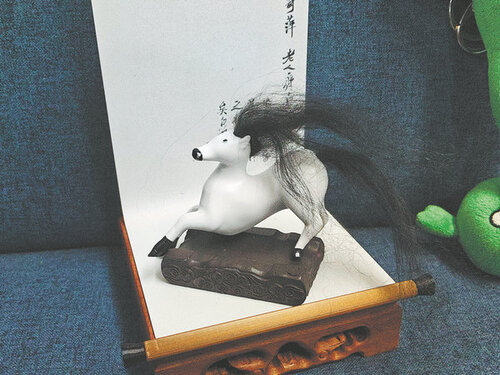
Ma Biaobiao, the little horse with fluffy mane. [Photo by Deng Zhangyu/China Daily]



 Investing
 Working
 Studying
 Living